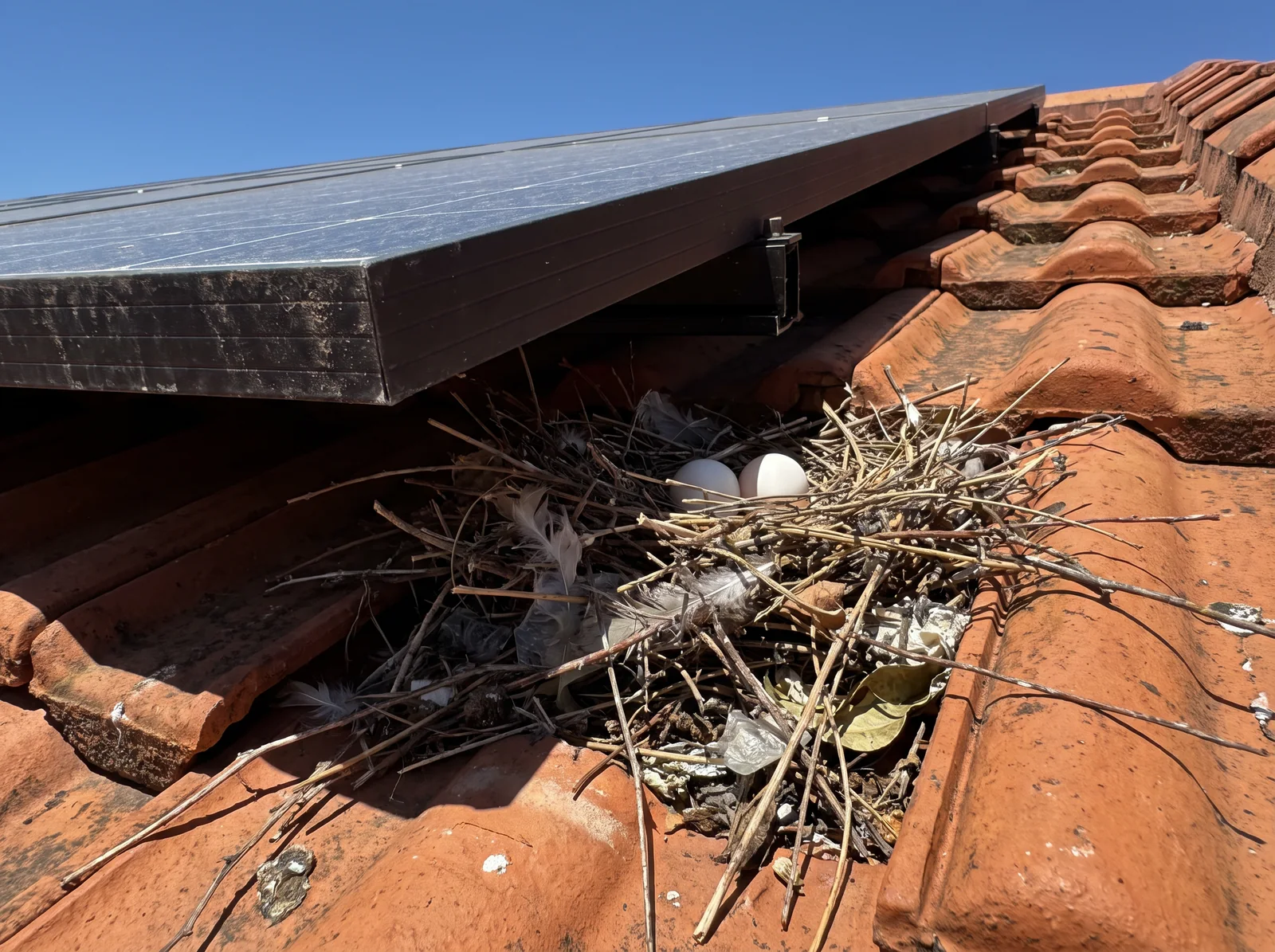
Where they nest
The University of Nevada, Reno Extension lists the places pigeons nest: window ledges and balconies, under bridges, in open warehouses and barns, behind and on signs, in soffits, and in the attics of houses, especially houses with tile roofs. The nest itself is a loose platform of sticks on a sheltered horizontal surface.
On a Las Vegas home that translates to the gap under a solar array, the open ends of the first row of roof tiles, the top of a rooftop air conditioning unit, the beams of a patio cover, and any parapet or ledge with cover above it.
Why solar arrays
A rooftop array is raised a few inches off the tiles. The space underneath is shaded, dry, out of the wind, warm at night and out of reach of cats and hawks. It is the best nesting site on the block, and it is hard for the homeowner to see into or reach.
A Las Vegas television report on a Summerlin home described the debris that collects under the panels where two roof sections meet, and a backyard, pool and trampoline covered in droppings from the flock above. Once a pair has bred under an array, the young return to the same roof.
How fast a pair becomes a flock
Pigeons breed all year in southern Nevada. The UNR Extension publication puts a typical pair at three to four clutches a year, one or two eggs each, with the eggs hatching in about 16 to 18 days and the young leaving the nest at four to six weeks. There is no off season, which is why a roof with two pigeons in spring can carry a dozen by fall.
What the droppings do
- Volume. The Southern Nevada Health District puts a well-fed pigeon at about 25 pounds of droppings a year.
- Surfaces. The uric acid in the white part of the droppings damages the finish on buildings and cars (UNR Extension). The health district lists buildings, vehicles, trees, shrubs, lawns and outdoor furniture as things the droppings damage.
- Other pests. Accumulated bird debris attracts mice, rats and flies (health district). Mites from the nests are the most common health complaint tied to pigeons (UNR Extension).
- Health. The health district lists histoplasmosis, cryptococcosis and psittacosis among the diseases pigeons can pass to people. The exposure route is dust from dried droppings. See the health guide.
What draws them to a property
Food and shelter. Bird seed, pet food left outside, fruit trees and spilled grain feed the flock; a roost with cover keeps it. Feeding wild pigeons is illegal on residential property throughout the valley, and the county code says why: roosting pigeons are a health and property hazard. Details and the code sections are in the legal guide.
What to do first
- Find the roost. Look under the solar array from the ground with binoculars, check the top of the AC unit, and look at the beams of the patio cover at dusk when the birds come in.
- Stop any feeding on the property, including bird feeders and pet food.
- Have the roost closed. Under solar panels that means screening; on ledges and patio covers it means spikes or netting; an established flock may need trapping as well. The nests and droppings are cleaned out first.
Sources
- University of Nevada, Reno Extension, Pigeons: Their Biology and Control (SP-02-11). https://extension.unr.edu/publication.aspx?PubID=3270
- Southern Nevada Health District, Pigeon Prevention and Clean-Up Guidelines. https://www.southernnevadahealthdistrict.org/Health-Topics/pigeon-prevention-clean-up-guidelines/
- KTNV Las Vegas, Solar panels act as perfect nesting spot for pigeons. https://www.ktnv.com/news/solar-panels-act-as-perfect-nesting-spot-for-pigeons
- Clark County Code 10.36.035, Pigeon control (Ord. 4539, November 7, 2017). http://clarkcounty-nv.elaws.us/code/coor_title10_ch10.36_sec10.36.035