The three diseases named locally
The Southern Nevada Health District states that pigeons can carry diseases and parasites that can be passed to people, and names three: histoplasmosis, cryptococcosis and psittacosis. All three are infections that begin in the lungs.
- Histoplasmosis is caused by a fungus that grows in soil enriched with bird or bat droppings. The CDC says large amounts of bird or bat droppings should be cleaned up by professional companies that specialize in hazardous waste removal.
- Cryptococcosis is caused by a fungus that, per the NIOSH page on related risks, lives in soil, decaying wood, tree hollows and bird droppings. Working near bird droppings may increase exposure.
- Psittacosis is a bacterial infection. The health district says people become infected when they inhale the bacteria present in dried bird droppings, feather dust or other secretions of infected birds, and lists pigeons among the birds that carry it. Pneumonia is common, and symptoms appear one to four weeks after exposure.
How exposure happens
Breathing dust. The CDC and NIOSH pages describe the route as inhaling aerosolized dried droppings, which happens when a dry accumulation is swept, scraped or blown. A pigeon walking across the patio is not the exposure; a leaf blower under a solar array full of dried droppings is.
Who is at higher risk
The CDC states that most cryptococcosis infections occur among people with weakened immune systems. NIOSH lists pest control workers, roofers and HVAC installers among the occupations with possible Histoplasma exposure, and says those workers should use NIOSH-approved particulate respirators. The people who clean a roost are the people most exposed to it.
Mites, rodents and flies
The UNR Extension publication calls mites the most common health problem tied to pigeons: bird mites leave the nest when the birds do and can end up indoors. The health district adds that accumulated bird debris attracts mice, rats and flies.
How cleanup is done safely
The health district publishes a cleanup protocol for pigeon droppings. In outline:
- Wear protection: long sleeves and pants, waterproof gloves, eye protection, a filter mask and closed-toe waterproof shoes.
- Mix one part household bleach to nine parts water and soak the droppings for ten minutes so nothing goes airborne.
- Scrape the wet material into doubled plastic bags.
- Scrub and rinse the surface, apply the bleach solution again and let it dry.
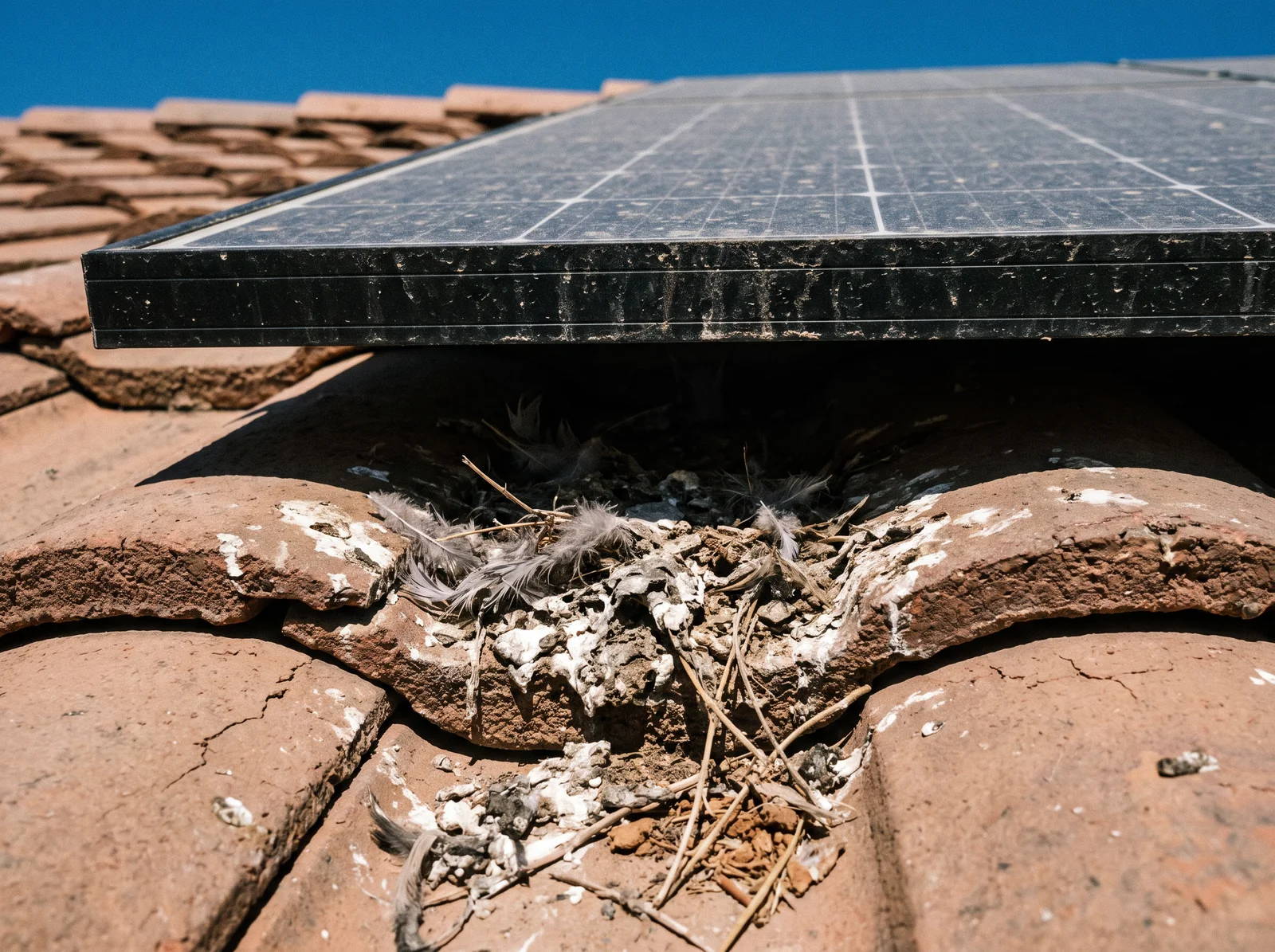
That protocol is for a small area a homeowner can reach. The CDC's guidance for large accumulations is professional cleanup. A season's worth of nests and droppings under a rooftop solar array is a large accumulation on a roof, which is the case for having it done as part of the cleanup and screening work.
What is not the case
Pigeons do not spread West Nile virus. The health district states that although the virus is found in pigeons, they are a dead-end host for it. Any claim that pigeons on the roof put a family at risk of West Nile is wrong.
Sources
- Southern Nevada Health District, Pigeon Prevention and Clean-Up Guidelines. https://www.southernnevadahealthdistrict.org/Health-Topics/pigeon-prevention-clean-up-guidelines/
- Southern Nevada Health District, Psittacosis (Ornithosis). https://www.southernnevadahealthdistrict.org/Health-Topics/psittacosis-ornithosis/
- CDC, Preventing Histoplasmosis. https://www.cdc.gov/histoplasmosis/prevention/index.html
- CDC NIOSH, Histoplasmosis: Related Risks (Cryptococcus and psittacosis). https://www.cdc.gov/niosh/histoplasmosis/related-risks/index.html
- CDC NIOSH, Histoplasmosis: Personal Protective Equipment. https://www.cdc.gov/niosh/histoplasmosis/prevention/personal-protective-equipment.html
- CDC, About Cryptococcosis. https://www.cdc.gov/cryptococcosis/about/index.html
- University of Nevada, Reno Extension, Pigeons: Their Biology and Control (SP-02-11). https://extension.unr.edu/publication.aspx?PubID=3270