Why pigeons nest under solar panels
A rooftop solar array sits a few inches above the tiles. That gap is shaded, dry, out of the wind, and out of reach of most predators. On a Las Vegas roof in summer it is one of the few cool spots available, and pigeons find it quickly. Once a pair nests there, the flock grows in place: pigeons breed all year in southern Nevada, three to four clutches a year is typical, and the young return to the roof they hatched on.
The result is nesting material packed under the panels, droppings streaking the tiles and the stucco below, and birds walking on the panels themselves. Dry nesting material packed against the wiring under the array is one of the reasons the mesh makers give for screening in the first place.
What screening involves
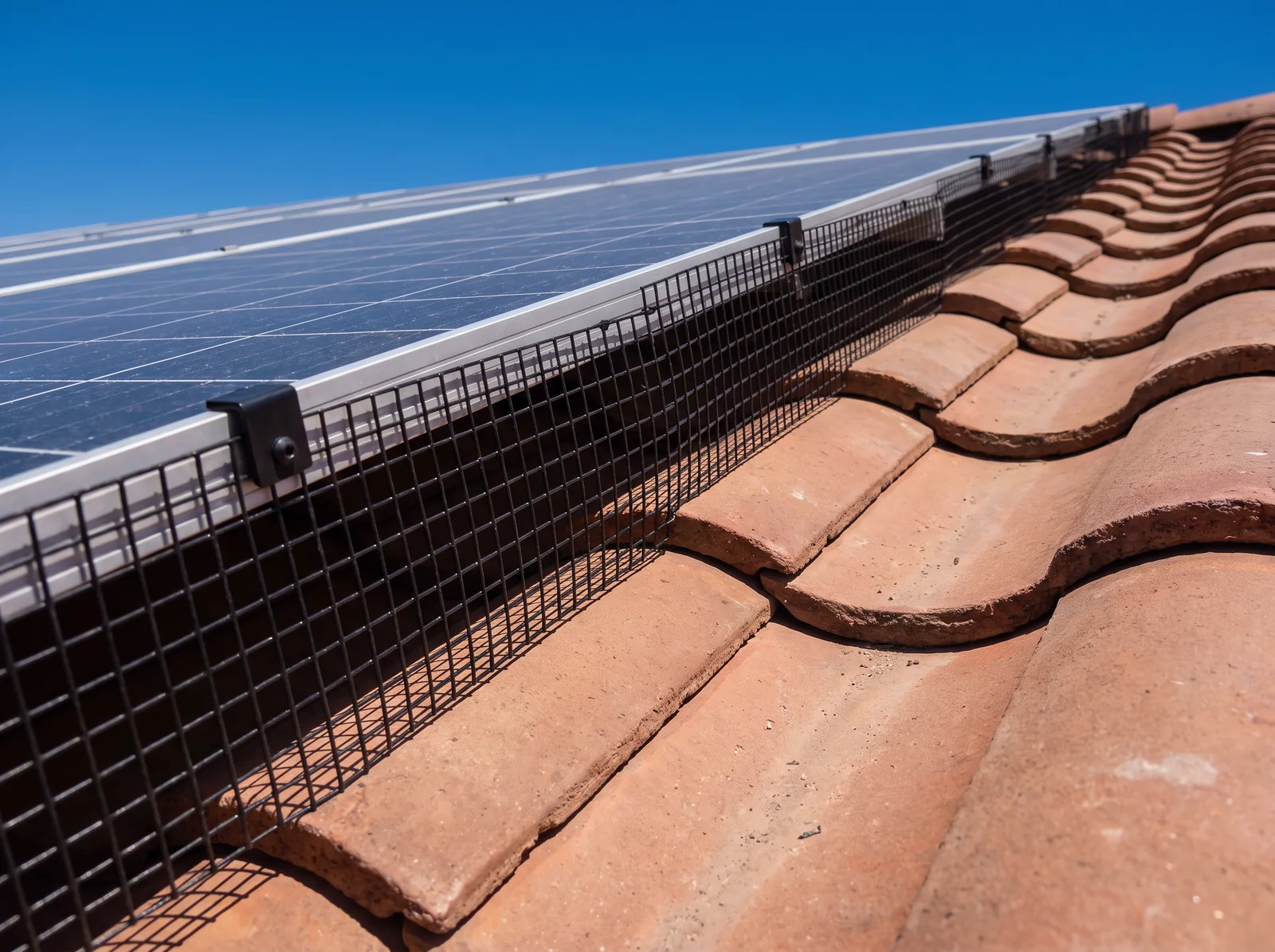
Solar panel screening (also called solar panel bird proofing or critter guard) closes the gap around the whole perimeter of the array so nothing can get underneath.
- The mesh. A galvanized steel wire mesh, usually vinyl coated in black so it disappears against the panel edge. The mesh is rigid enough to hold its shape and fine enough that a pigeon cannot push through it.
- The clips. The mesh is held to the panel frame with purpose-made clips that grip the frame edge. There is no drilling into the panels, the racking or the roof tiles, so the panel seals and the roof are not disturbed.
- The fit. The mesh follows the tile profile along the bottom edge, so the gap between the mesh and the curved tiles is closed as well. Corners and the places where the array steps up or down are the spots most often left open by a rushed job, so ask that they are covered.
- Odd shapes. Arrays that wrap around vents, skylights or a chimney need the mesh cut and fitted around each obstacle.
Screening keeps pigeons out. It does not stop them landing on the panels or the ridge, so a roof with a heavy flock may also need spikes or a trapping program before the birds move on.
Cleanup comes first
Screening over an occupied roost traps the nests, eggs and droppings under the panels. The nests and debris under the array are cleared and the tiles and panels are cleaned before the mesh goes on. On a heavily used roof this is the larger part of the job. See dropping and nest cleanup for what that involves and the health guidance behind it.
What to expect from the visit
- A look at the array. How many panels, how the array is laid out, the roof pitch and height, and whether the roof is tile, shingle or flat.
- A look under the panels. Whether there are active nests and how much material and droppings have built up.
- The work and the price. Screening, cleanup, and any spikes or trapping that also apply, with the price confirmed before you agree to anything.
Two things to ask the provider directly: what clip system they use on your panel frame, and whether your solar installer has any conditions on third-party work around the array.
Questions about solar panel screening
Does screening reduce the output of the panels?
The mesh sits around the edge of the array below the panel surface and does not shade the cells. It does not sit on top of the glass.
Can the mesh be removed if a panel needs service?
Yes. Clip-on mesh unclips from the frame and can be refitted after the panel work. Tell your solar technician it is there.
What if the pigeons are already nesting with eggs?
The nests and eggs are removed as part of the cleanup before screening. Feral pigeons are not protected under federal migratory bird law; see the legal guide.
Will they just move to the ridge or the neighbor's roof?
Often, yes. Screening removes the nesting site, which is what holds a flock to a roof. Birds that keep landing on the ridge or the panel surface can be dealt with by spikes or a trapping program.
Sources
- University of Nevada, Reno Extension, Pigeons: Their Biology and Control (SP-02-11). https://extension.unr.edu/publication.aspx?PubID=3270
- Bird B Gone, Solar Panel Bird Deterrent Kit. https://www.birdbgone.com/solar-panel-bird-deterrent-kit/
- Bird Barrier, Solar Panel Protection Wire Mesh. https://birdbarrier.com/solar-panel-protection-wire-mesh/
- Nixalite, SolarGuard Solar Panel Exclusion. https://www.nixalite.com/product/solar-panel-exclusion
- KTNV Las Vegas, Solar panels act as perfect nesting spot for pigeons. https://www.ktnv.com/news/solar-panels-act-as-perfect-nesting-spot-for-pigeons